Guided Fishing in Minnesota: What to Expect on a Trip
Most people booking guided fishing in Minnesota have never fished a river out of a jet boat, and they show up with a handful of questions they never got around to asking. What time do we start? Do I need to bring anything? Am I going to embarrass myself out there?
Fair questions, all of them — and among the more common things we get asked about guided fishing trips up here. So here’s the whole thing laid out: what a day on the Upper Mississippi and Crow Wing rivers between Brainerd and Little Falls actually looks like, start to finish, gear to rates.
What a Guided Fishing Trip in Minnesota Looks Like
We’ll call you the day before your trip to confirm the meeting time and place and answer whatever’s still on your mind.
Typical meet time is 7:45 at the boat ramp. We load your gear, run upriver in the jet boat to wherever we’re starting for the day, and fish our way back down from there. Most of the day is spent rowing drift boat style while you cast to the bank, to mid-river structure, or to weeds. In certain spots we’ll switch to the trolling motor and work upstream to island tail-outs, ledges, and slots — it’s a quieter approach and the fish notice the difference.
The boat has elevated casting decks front and rear, which works well for fly and light tackle anglers alike. We fish from 8 AM to 2 PM on a full day and then head back to the ramp.
It’s your day, so tell us what you want out of it. Some people want numbers. Some want one big fish. Some want to spend six hours getting better at casting and reading water. All three are fine — and honestly, a good share of the job is just talking through what we’re seeing and why.
What’s Included and What You Bring
We guide both fly and light tackle anglers and provide all the rods, reels, and tackle you’ll need. Fly setups are 7 and 8 weights with floating or intermediate lines; spinning and baitcasting gear is on board too. We also bring a large cooler with ice, drinking water, life jackets, and bug spray.
Bring your own rods if you’d rather — plenty of people do, and there’s nothing wrong with having something familiar in your hands.
What you bring
A valid Minnesota fishing license — required for every angler, so get yours before you show up. Buy one online from the Minnesota DNR.
Any food and drinks you want for the day
Polarized sunglasses
Rain jacket
Sun protection
Your own bug spray if you’re particular about it
One thing worth saying plainly: leave the big tackle bag at home. The most common mistake we see is anglers hauling along everything they own. Almost none of it gets used, most of it isn’t right for this river, and with three people in the boat it just ends up underfoot. Trust your guide on baits, flies, line choice, and rigging — that’s what you’re paying for.
A few house rules: catch and release only, artificials and flies only, no live bait. Two anglers max plus the guide. Kids 10 and up are welcome and count as anglers. Alcohol’s fine in moderation. No glass on the river — that one’s state law, not ours.
A River Trip Isn’t a Lake Charter
River smallmouth are a different game from lake smallmouth, especially in summer, and this is the part that catches people off guard.
We almost always start out power fishing — moving baits and flies that cover water and find active fish. Finesse techniques come later, and only once we’ve found fish in an area. The fish hold tight to the bank, to boulders, eddies, weeds, and current seams. Reading that water and putting the cast where it belongs is what separates a good day from a slow one.
Two things make it demanding. The boat is moving, so you don’t get multiple casts at a target — you get one, maybe two. And the water is shallow: almost always less than four feet, usually less than two. We can’t ease up on top of the fish without spooking them, which means the cast has to travel.
Thirty feet, reasonably accurate, with a fly rod or light tackle — that’s the working number out here. The less accurate you are, the closer we have to get, and the less you’ll catch. The big fish get big for a reason. They’re the most sensitive to a boat and the least forgiving of a bad cast.
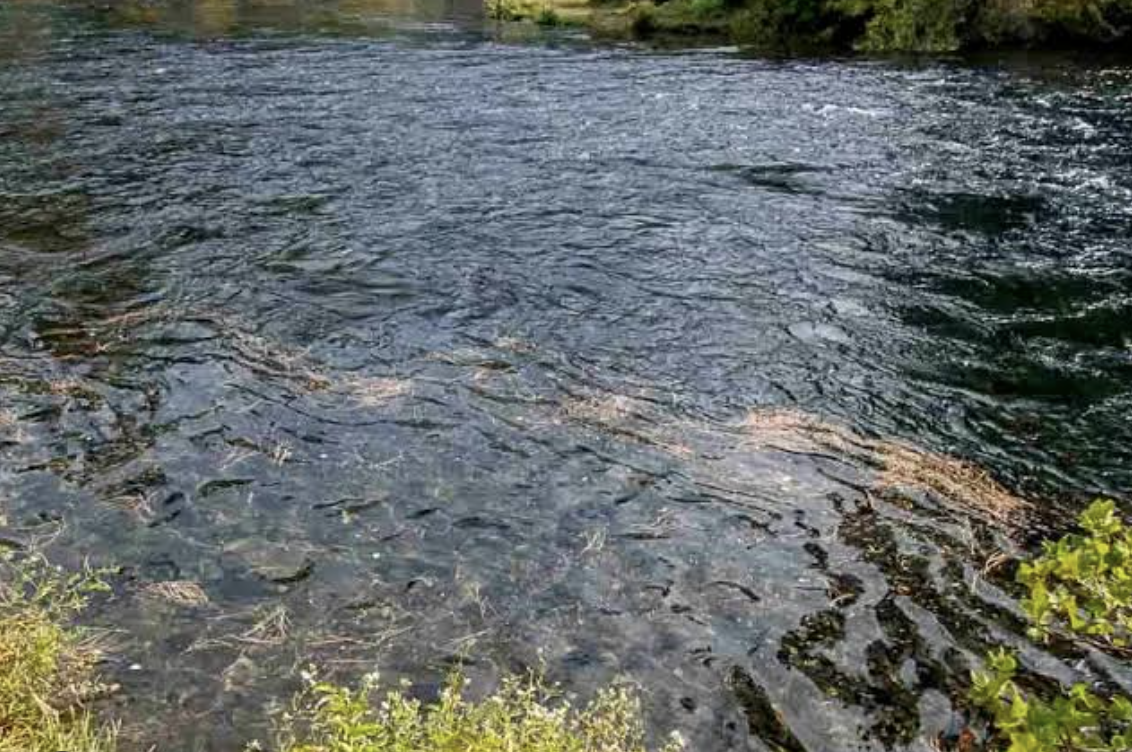
River seam with an eddy
The cast you want is usually upstream and about 30 degrees off to the side, so the fly comes down to the fish the way its food normally does and your line never passes over the top of it. Land it within a foot of the target and you’re in business. Come at that same fish from a different angle and plenty of them just won’t turn.
Pace matters as much as accuracy. Most clients fish far slower than they should — a guide’s rate of casting and retrieving runs about three times theirs. There’s a lot of food in this river, so fish generally won’t travel far to eat. You have to bring the fly to them, and you have to cover water to find the ones that are willing.
Fly selection runs bigger than people expect, too. Your fly often needs to be larger than what the fish are normally eating, and that goes double for the better fish. If your reference point is lake fishing with Livescope and finesse baits, this is a different sport.
When to Go
Depending on spring weather, fishing usually starts around May 1st, with pre-spawn fish moving up out of deeper water toward their spawning areas. The Crow Wing River is an outstanding spawning area — clear water, the right bottom, and plenty of food — and under normal conditions we’d take the Crow Wing over the Mississippi early in the season. The Mississippi can run high and dirty in spring, and smallmouth are sight predators, so clarity matters. Here’s the full seasonal breakdown of the Crow Wing.
By July the fish have mostly moved out of the Crow Wing and into their summer areas on the Mississippi. They hold tight to banks, shade, and blowdowns, and topwater can be excellent when they’re on it. In a low, clear water year they stack into whatever pockets still hold flow and depth — harder to find, but very good once you do.
As fall comes on, the fish group up, feed more aggressively, and start their transition downstream toward the deeper water near the Little Falls dam. Finding them takes more work this time of year. When you do, it can be some of the best fishing of the season.
If you want more on the fishery itself, we go deeper on the Upper Mississippi here.
Do You Need Experience?
Anglers of every level are welcome, and we’re happy to work with you on reading water, casting, retrieves, and fighting fish. A good share of the job is teaching.
Being straight with you, though: you should be able to cast reasonably accurately with a spinning rod, a casting rod, or a fly rod to get the most out of the day. We can put you where the fish are. We can’t read the water, make the cast, work the fly, or land the fish for you. If you’re fly fishing, skill level matters even more. Keep your expectations in line with where your casting is right now and you’ll have a good day.
Which brings us to the single most useful thing you can do before your trip.
Practice your cast
Whatever gear you plan to fish, practice with it. Accuracy, distance, and efficiency are what matter, and the ability to make those casts repeatedly makes a massive difference on the water. If you can’t do those things, none of the rest of it matters much — casting is the foundation everything else sits on.
Go out in the yard or to a park, measure off 30 feet, tie on a streamer, and throw at a target. Fifteen minutes a few times before your trip changes the whole day.
Start looking at water differently
You don’t need to be an expert. But showing up already thinking about where a fish would sit — the downstream edge of a boulder, a current seam, shade under a blowdown — means you’re ready when we come up on one instead of reacting late. We’ll point out spots all day. The anglers who get the most out of it are the ones already looking.
Decide what you want out of the day
Numbers, one big fish, or six hours of getting better at casting and reading the river. Those are three different days, and it helps to know which one you’re after before we push off. Tell your guide at the ramp.
A story that makes the point better than any advice can. Two anglers booked a trip and told us up front they were expert fly fishermen. They brought their own flies — the wrong ones for this water — and stubbornly fished them anyway. Neither could cast well. Between them they caught nothing, and by mid-morning they were fairly sure there were no fish where we’d taken them. Eventually one of them set the fly rod down, picked up a spinning rod, and proceeded to catch fish after fish while his buddy kept blanking. The fish were there the whole time.
So if the fly rod isn’t clicking on a given day, switch. Fly, light tackle, or both — nobody’s keeping score, and the point is to catch fish.
Rates for Guided Fishing Trips
Half day — 4 hours — $350 — one or two anglers
Full day — 6 hours — $500 — one or two anglers
A 50% deposit holds your date and is refundable up to 30 days before the trip. The balance is charged two days out. If weather or river conditions force a cancellation and we can’t reschedule to your satisfaction, you get a full refund.
Whether it’s your first time out or your fifteenth season chasing guided smallmouth bass fishing in Minnesota, we’d love to get you on the water. The easiest way to book is the online booking tool right here on the site, which shows current trip availability. You can also reach out directly — text or email is best, since we’re on the river most days. steve@northfishangling.com · 612-360-7609.